

Group Leader
Dr. Alexander Lercher
Department of Infectious Diseases, Integrative Virology
alexander.lercher@med.uni-heidelberg.de
Phone: +49 6221 56–318452
Inflammatory signal integration and epigenetic memory in viral disease.
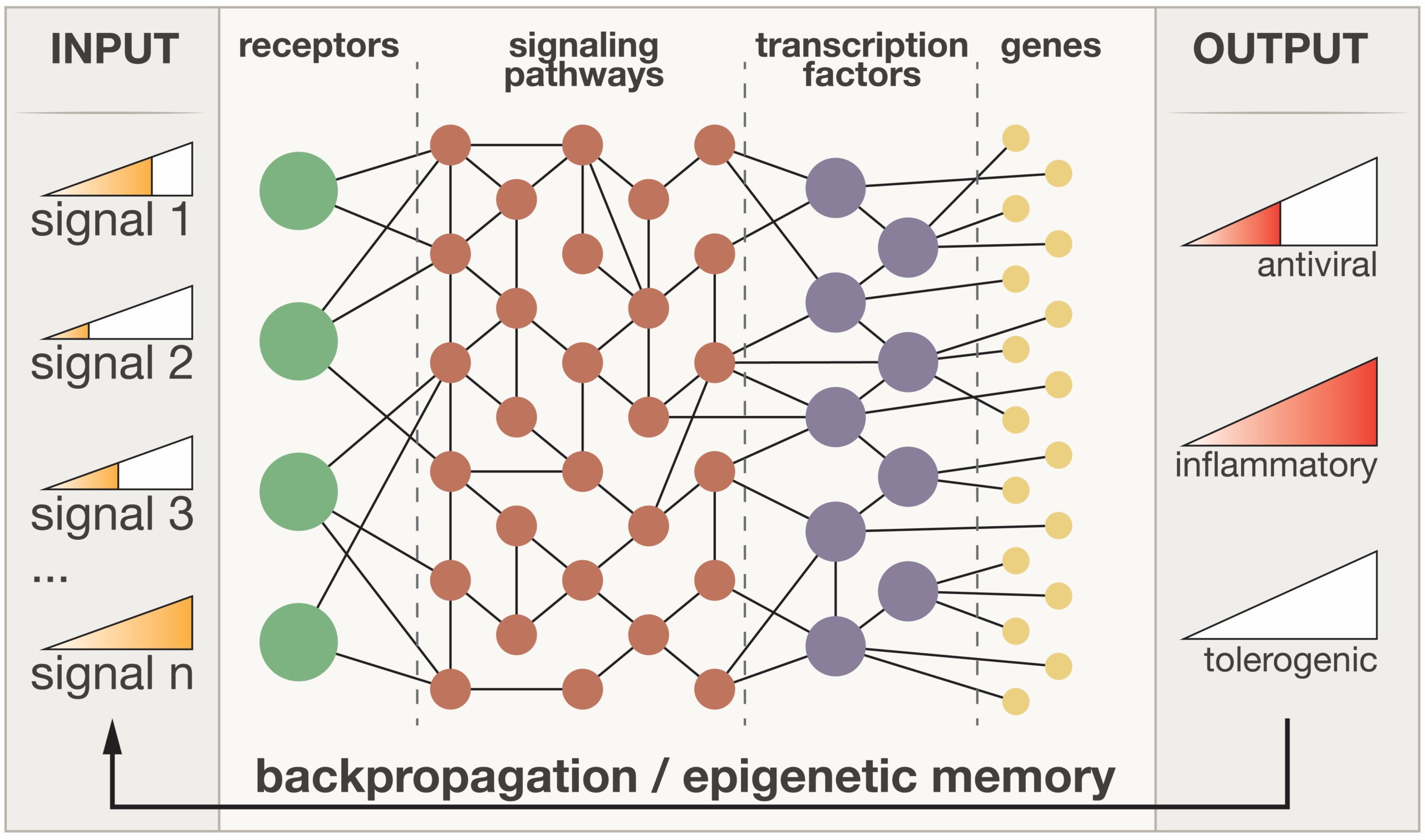
Humans encounter a plethora of microbes daily. Immune cells are the first responders to fend off pathogens, but can also cause life-threatening hyperinflammatory dysregulation. We focus on viral infection, where this balance is particularly precarious. Viruses and cytokines are prime inducers of inflammation, but cell-intrinsic and extrinsic factors, including cell identity, tissue environment and even diet, influence immune responses. Another regulatory layer comes from past inflammatory encounters, which result in durable epigenetic memory that alters secondary immune responses.
There is a gap in our understanding of how cells integrate this myriad of immunological and environmental cues to mount adequate acute responses and establish epigenetic memory. In the Lercher lab, we take a holistic approach to map the underlying molecular networks and decipher the black box of inflammatory signal integration and memory formation. We combine tractable primary cell culture systems with mouse models of viral infection to recapitulate real-world pathogen encounters. Using next-generation sequencing, real-time imaging, genetic engineering and immune profiling, we aim to build a framework of signal integration and cell-cell communication across tissues in health and disease. Our overarching goal is to uncover fundamental principles of immunity that underlie disease development, progression and resolution, to enable new therapeutic approaches and boost pandemic preparedness.
Research Questions
+ How do cells integrate inflammatory cues to mount adequate immune responses?
+ What are the determinants of cell-type or tissue-specific immune responses?
+ How do innate immune responses lead to durable epigenetic memory?
+ Which cellular and cross-organ communication networks shape innate immunity and memory?
+ Can we use synthetic immunology to build circuits that control complex immune responses?
Full publication list:
https://www.ncbi.nlm.nih.gov/myncbi/alexander.lercher.2/bibliography/public/
Lewy T, Sierra MA, Pourshadi N, Hoffmann HH, Dinnon KH 3rd, Gola A, Wang W, Chen HA, Quirk C, Zhang H, Doyle MP, Mason CE, Diehl GE, Hohl TM, Fuchs E, MacDonald MR, Wu Z, Crowe JE Jr, Rice CM*, Lercher A*. Brain endothelial cells orchestrate a neuroprotective antiviral state in the CNS in response to peripheral viral pattern sensing. Immunity. 2026
Link: https://www.cell.com/immunity/fulltext/S1074-7613(26)00260–8
Lercher A, Cheong JG, Bale MJ, Jiang C, Hoffmann HH, Ashbrook AW, Lewy T, Yin YS, Quirk C, DeGrace EJ, Chiriboga L, Rosenberg BR, Josefowicz SZ, Rice CM. Antiviral innate immune memory in alveolar macrophages following SARS-CoV‑2 infection ameliorates secondary influenza A virus disease. Immunity. 2024
Link: https://www.cell.com/immunity/fulltext/S1074-7613(24)00417–5
Lercher A, Popa AM, Viczenczova C, Kosack L, Klavins K, Agerer B, Opitz CA, Lanz TV, Platten M, Bergthaler A. Hepatocyte-intrinsic type I interferon signaling reprograms metabolism and reveals a novel compensatory mechanism of the tryptophan-kynurenine pathway in viral hepatitis. PLoS Pathogens. 2020
Link: https://journals.plos.org/plospathogens/article?id=10.1371/journal.ppat.1008973
Lercher A, Baazim H, Bergthaler A. Systemic Immunometabolism: Challenges and Opportunities. Immunity. 2020
Link: https://www.cell.com/immunity/fulltext/S1074-7613(20)30369–1
Lercher A, Bhattacharya A, Popa AM, Caldera M, Schlapansky MF, Baazim H, Agerer B, Gürtl B, Kosack L, Májek P, Brunner JS, Vitko D, Pinter T, Genger JW, Orlova A, Pikor N, Reil D, Ozsvár-Kozma M, Kalinke U, Ludewig B, Moriggl R, Bennett KL, Menche J, Cheng PN, Schabbauer G, Trauner M, Klavins K, Bergthaler A. Type I Interferon Signaling Disrupts the Hepatic Urea Cycle and Alters Systemic Metabolism to Suppress T Cell Function. Immunity. 2019
Link: https://www.cell.com/immunity/fulltext/S1074-7613(19)30458–3