


Dr. Markus Ganter
markus.ganter
(at)med.uni-heidelberg.de
Phone: +49 6221 56–7877
Fax: +49 6221 56–5751
Nuclear Autonomy in Multinucleated Cells
Projects
Cells usually multiply by duplicating their genome and divide themselves into two daughter cells. Yet, in some organisms, cellular multiplication follows distinct, somewhat bizarre routes. One of these rather unusual ways can be seen in Plasmodium spp., the causative agent of malaria. An unusual feature of Plasmodiumreplication inside erythrocytes, known as schizogony, is the number of nuclei and, hence, daughter cells they produce during one round of intracellular replication. Parasites with odd numbers of nuclei can be readily seen (Fig. 1). Divergence from a geometric expansion (e. 2, 4, 8, 16, or 32) is caused by asynchronous replication, suggesting that individual nuclei replicate autonomously until a global mechanism takes over and co-ordinates daughter cell formation. This is in striking contrast with nuclear division in other multinucleated cells, such as the early Drosophila embryo, where nuclei follow a geometric expansion, as their division is relatively synchronous. To gain insight into the regulation of Plasmodium falciparum replication, we conducted a forward genetic screen for the conditional protein expression of protein kinases and identified a kinase as essential for proliferation (Fig. 2). This kinase is Plasmodium-specific and a crucial regulator of the continuous rounds of DNA replication, histone modification, and regulation of gene expression. We also found that this kinase is required for transmission to the mosquito. This work serves as a starting point to gain a better understanding of nuclear autonomy in Plasmodium.

Figure 1 | Nuclei divide autonomously in Plasmodium. Odd numbers of nuclei can be readily seen during the development of P. falciparum.
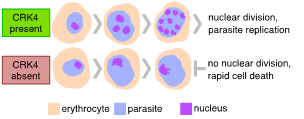
Figure 2 | Plasmodium falciparum CRK4 is essential for replication in the pathogenic blood stage of infection.
1 | Analysis the spatiotemporal parameters of nuclear autonomy
To analyze the spatiotemporal parameters of nuclear autonomy, we are using live-cell microscopy. In a set of reporter parasites, we determine the dynamics of DNA replication, nuclear division, and organelle development. These data inform on a mathematical model, describing nuclear autonomy in P. falciparum (Fig. 3).
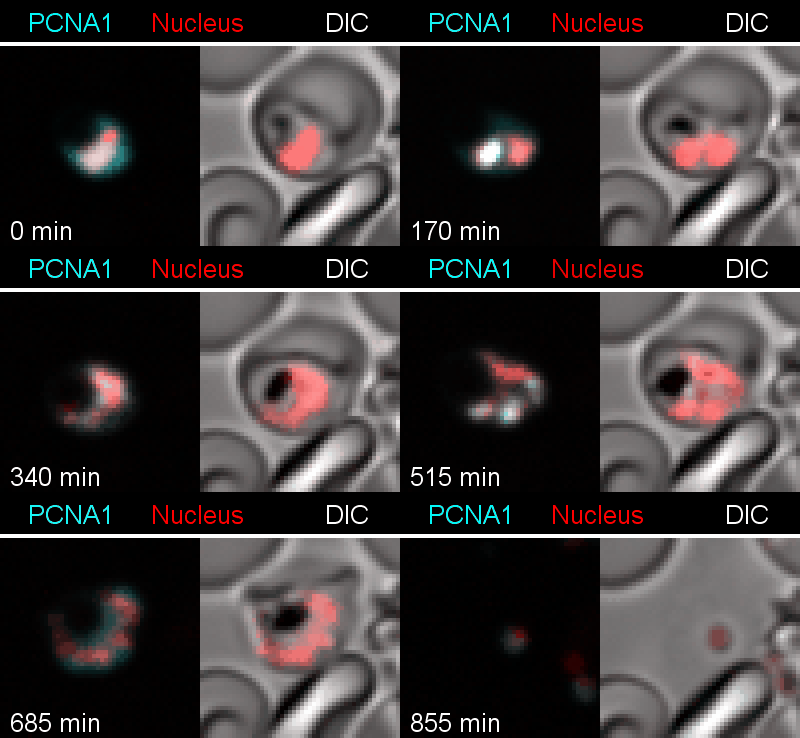
Figure 3 | Plasmodium falciparum reporter cell line. The nuclei of the parasites are marked with a red-fluorescent protein and a component of the DNA replication machinery (PCNA) is marked in cyan.
2 | Regulation of autonomous nuclei replication
To understand how autonomous nuclei regulate their replication, we want to describe the signalling cascade that orchestrates DNA replication in individual nuclei. For this we are using the mayor S‑phase regulator PfCRK4 as a starting point and are currently defining its interactome. This work will inform on substrates of the kinase as well as on upstream regulators.
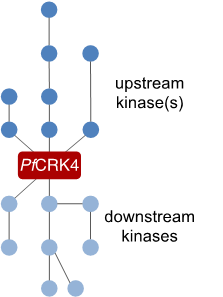
Figure 4 | Cartoon representing the elusive signalling cascade, which triggers PfCRK4.
3 | Function of regulators and effectors in asynchromous DNA replication
Our previous work suggests that a set of proteins of unknown function is involved in DNA replication and nuclear division. These proteins were identified through phosphoproteomic profiling of PfCRK4 and showed a much-reduced phosphorylation in absence of the kinase. To characterize the function of these regulators and effectors involved in asynchronous DNA replication, we are using reverse genetic tools and inducible gene-depletion approaches.
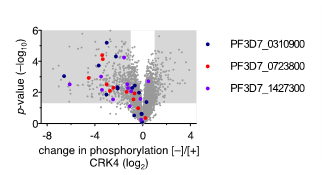
Figure 5 | Change in phosphorylation of three proteins of unknown function in absence of CRK4. Phosphoproteomic profiling of PfCRK4-depleted parasites. Grey areas indicate phosphopeptides with a ≥2‑fold change in phosphorylation and p<0.05.
- Weber S, Jeske R, Adegbite B, Glaser A, Moure P, Mouloungui-Mavoungou J, Rabone M, Emery A, Aka N, Jung H, Büchler C, Sorgho-Mitreska E, Tobian F, Plutowski-Wrobel L, Ganter M, Lanzer M, Velavan T, Grobusch M, Denkinger C, Waterboer T, Adegnika A, Bélard S. Clinical evaluation of recombinant antigen ELISAs and broad-range helminth PCRs for the diagnosis of human paragonimiasis in Gabon (in press, Tropical Medicine and Health).
- Zink L, Reuschenbach V, Sid Ahmed S, Lauer M, Niethammer J, Kudulyte A, Zorko K, Fackler OT, Hentzschel F, Ganter M. A genetically encoded marker for imaging membranes of Plasmodium. Molecular Microbiology, doi: 10.1111/mmi.70098, PMID: 42742062 (2026).
- Binder P, Kudulyte A, Klaus S, Höfter T, Schwarz USS, †Ganter M, †Becker N. Competitive resource allocation drives asynchronous and rapid nuclear multiplication in the malaria parasite. Nature Communications, 17, 7413, doi: 10.1038/s41467-026–75378‑x, PMID: 42509239 (2026).
- Sütterlin JM, Ganter M. Shaping an image: 3D-printable models of parasites. Trends in Parasitology, in press, doi: 10.1016/j.pt.2026.06.007 (2026)
- Dey G, Ganter M, Jacobovitz M. Multinucleation as a recurring evolutionary strategy for scaling and plasticity. Current Biology, 36, R450–R463, doi: 10.1016/j.cub.2026.03.066, PMID: 42150533 (2026).
- Malych R, Bordat Y, Klanicova K, Arbon D, Zahedifard F, Sipkova A, Drncová E, Levytska V, Mach J, Plutowski-Wrobel L, Machado M, Stursa J, Truksa J, Ganter M, Sojka D, Zoltner M, Besteiro S, Werner L, Sutak R. Modular Design of Mitochondrion-Targeted Iron Chelators Allows Highly Selective Antiparasitic Activity against Trypanosomes and Apicomplexan Parasites. ACS Infectious Diseases, doi: 10.1021/acsinfecdis.5c00548, PMID: 41428959 (2025).
- Nikolova V, Linnemannstoens K, Bendel M‑E, Machado M, Ganter B, Budimir P, Vogts M, Ganter M, Meier C, Dobbelstein M. Membrane-permeable 5‑fluorodeoxyuridine triphosphate derivatives inhibit the proliferation of Plasmodium falciparum. ACS Infectious Diseases, doi.org/10.1021/acsinfecdis.5c00544, PMID: 41042506 (2025).
- Nikolova V, Linnemannstoens K, Zahoruiko A, Ganter M, Lueder CG, Dobbelstein M. Synergistic activity of the ferroptosis inducer RSL3 and Pyrimethamine to inhibit the proliferation of Plasmodium falciparum. Antimicrobial Agents and Chemotherapy, e0047125, PMID: 40823867 (2025)
- Dupouy B, Cotos-Munoz L, Binder A, Borkova L, Rottmann M, Mäser P, Jacquemin D, Ganter M, Davioud-Charvet E, Elhabiri M. Click Coupling of Flavylium Dyes with Plasmodione Analogues: Towards New Redox-Sensitive Pro-Fluorophores. Chemistry — A European Journal, 31, e202403691, PMID:39654502 (2025)
- Darif N‑D, Ganter M, Dziekan JM, Kilian N, Brancucci N, Ng C, de Vries LE, Guttery D, Philip N, Boddey JA, Metwally NG, Okumu F, Kooij TWA, Absalon S, Bryant JM. BioMalPar XX: looking back on, and forward from, 20 years of malaria research. Trends in Parasitology, doi.org/10.1016/j.pt.2024.06.012, PMID: 39013661 (2024)
- Arbon D, Mach J, Sipkova A, Štursa J, Klanicova K, Machado M, Ganter M, Levytska V, Sojka D, Truksa J, Werner L, Sutak R. Chelation of mitochondrial iron as an antiparasitic strategy. ACS Infectious Diseases, 10, 676–687, PMID: 38287902 (2024)
- Voß Y, Klaus M, Nicolas P. Lichti, Ganter M, Guizetti J. Malaria parasite centrins assemble by Ca2+-inducible condensation. Plos Pathogens, 19, e1011899, PMID: 38150475 (2023)
- Machado M, Klaus S, Klaschka D, Guizetti J, Ganter M. Plasmodium falciparum CRK4 links early mitotic events to the onset of S‑phase during schizogony. mBio, e0077923, PMID: 37345936 (2023)
- Wenz C, Simon CS, Romão TP, Stürmer V, Machado M, Klages N, Klemmer A, Voß Y, Ganter M, Brochet M, Guizetti J. An Sfi1-like centrin-interacting centriolar plaque protein affects nuclear microtubule homeostasis. Plos Pathogens, 19, e1011325, PMID: 37130129 (2023)
- Voß Y, Klaus S, Guizetti J, Ganter M. Plasmodium schizogony, a chronology of the parasite’s cell cycle in the blood stage. Plos Pathogens, 19, e1011157, PMID: 36862652 (2023)
- Ganter M, Guizetti J, Kilian N. Visualization of Infected Red Blood Cell Surface Antigens by Fluorescence Microscopy. In Malaria Immunology, Targeting the Surface of Infected Erythrocytes, edited by Ramstedt Jensen AT, Hviid L. Methods in Molecular Biology, 2470:425–433, PMID: 35881363 (2022)
- Arbon D, Ženíšková K, Šubrtová K, Mach J, Štursa J, Machado M, Zahedifard F, Leštinová T, Hierro Yap C, Neuzil J, Volf P, Ganter M, Zoltner M, Zíková A, Werner L, Sutak R. Repurposing of mitochondria-targeted tamoxifen: Novel anti-cancer drug exhibits potent activity against major protozoan and fungal pathogens. Antimicrobial Agents and Chemotherapy, e00727-22, PMID: 35856666 (2022)
- Klaus S, Binder P, Kim J, Machado M, Funaya C, Schaaf V, Klaschka D, Kudulyte A, Cyrklaff M, Laketa V, Hoefer T, Guizetti J, Becker N, Frischknecht F, Schwarz US, Ganter M. Asynchronous nuclear cycles in multinucleated Plasmodium falciparum enable rapid proliferation. Science Advances, 8(13):eabj5362, PMID: 35353560 (2022)
- *This paper was the subject of a Trends in Parasitology Spotlight, Liffner, B. & Absalon, S. 2022. Hand-in-hand advances in microscopy and Plasmodium nuclear biology. Trends in Parasitology, 38:421–423
- #The corresponding preprint was the subject of a preLight article by João Mello-Vieira (05/2021), doi.org/10.1242/prelights.29113
- Vandorpe DH, Rivera A, Ganter M, Dankwa S, Wohlgemuth J, Dlott J, Snyder LM, Brugnara C, Duraisingh MT, Alper SL. Purinergic signaling is essential for full Psickle activation by hypoxia and by normoxic acid pH in mature human sickle red cells and in vitro-differentiated cultured human sickle reticulocytes. Pflügers Archiv — European Journal of Physiology, 474(5):553–565, PMID: 35169901 (2022)
- Schumann R, Bischoff E, Klaus S, Möhring S, Flock J, Keller S, Remans K, Ganter M, Deponte M. Protein abundance and folding rather than the redox state of Kelch13 determine the artemisinin susceptibility of Plasmodium falciparum. Redox Biology, 48: 102177, PMID: 34773836 (2021)
- Simon CS, Voss Y, Funaya C, Machado M, Penning A, Klaschka D, Cyrklaff M, Kim J, Ganter M, Guizetti J. An extended DNA-free intranuclear compartment organizes centrosomal microtubules in malaria parasites. Life Science Alliance, 4: e202101199, PMID: 34535568 (2021)
- *This paper was the subject of a Trends in Parasitology Spotlight, Liffner, B. & Absalon, S. 2022. Hand-in-hand advances in microscopy and Plasmodium nuclear biology. Trends in Parasitology, 38:421–423
- Ganter M and Frischknecht F. Illuminating Plasmodium invasion by lattice light sheet microscopy. Trends in Parasitology, 37:777–779 PMID: 34332896 (2021)
- Machado M, Steinke S, Ganter M. Plasmodium Reproduction, Cell Size, and Transcription: How to cope with increasing DNA content? Frontiers in Cell Infection Microbiology, 11, 660679, PMID: 33898332 (2021)
- Pape C, Remme R, Wolny A, Olberg S, Wolf S, Cerrone L, Cortese M, Klaus S, Lucic B, Ullrich S, Anders-Össwein M, Wolf S, Berati C, Neufeld C, Ganter M, Schnitzler P, Merle U, Lusic M, Boulant S, Stanifer M, Bartenschlager R, Hamprecht FA, Kreshuk A, Tischer C, Kräusslich H‑G, Müller B and Laketa V. Microscopy-based assay for semi-quantitative detection of SARS-CoV‑2 specific antibodies in human sera. BioEssays, 2000257, PMID: 33377226 (2021)
- Quadt K, Smyrnakou X, Frischknecht F, Böse G, Ganter M. Plasmodium falciparum parasites exit the infected erythrocyte after haemolysis with saponin and streptolysin O. Parasitology Research, 119:4297–4302, PMID: 33089360 (2020)
- Przyborski J and Ganter M. Das ungewöhnliche Leben der Malariaparasiten. Biologie in Unserer Zeit, 48,162–169; doi.org/10.1002/biuz.201810646 (2018)
- Ganter M, Goldberg JM, Dvorin JD, Paulo JA, King JG, Tripathi AK, Paul AS, Yang J, Coppens I, Jiang RHY, Elsworth B, Baker DA, Dinglasan RR, Gygi SP, Duraisingh MT. Plasmodium falciparum CRK4 directs continuous rounds of DNA replication during schizogony. Nature Microbiology, 2(5):17017, PMID: 28211852 (2017)
- Paul AS, Saha S, Engelberg K, Jiang RHY, Coleman BI, Kosber AL, Chen C, Ganter M, Espy N, Gilberger TW, Gubbels MJ, Duraisingh MT. Parasite calcineurin regulates host cell recognition and attachment by apicomplexans. Cell Host Microbe, 18:49–60, PMID: 26118996 (2015)
- Ganter M, Rizopoulos Z, Schuler H, Matuschewski K. Pivotal and distinct role for Plasmodium actin capping protein alpha during blood infection of the Malaria parasite. Molecular Microbiology, 96:84–94, PMID: 25565321 (2015)
- Coleman BI, Skillman KM, Jiang RHY, Childs LM, Altenhofen LM, Ganter M, Leung Y, Goldowitz I, Kafsack BFC, Marti M, Llinas M, Buckee CO, Duraisingh MT. A Plasmodium falciparum histone deacetylase regulates antigenic variation and gametocyte conversion. Cell Host Microbe, 16:177–186, PMID: 25121747 (2014)
- ¶ Sattler J, ¶ Ganter M, Hliscs M, Matuschewski K, Schuler H. Actin regulation in the malaria parasite. European Journal of Cell Biology, 90:966–971, PMID: 21256619 (2011)
- ¶ Siden-Kiamos I, ¶ Ganter M, Kunze A, Hliscs M, Steinbüchel M, Mendoza J, Sinden R, Louis K, Matuschewski K. Stage-specific depletion of myosin A supports an essential role in motility of malarial ookinetes. Cellular Microbiology, 13(12):1996–2006, PMID: 21899701 (2011)
- Ganter M, Schuler H, Matuschweski K. Vital role for the Plasmodium capping protein (CP) beta subunit in motility of malaria sporozoites. Molecular Microbiology, 74:1356–1367, PMID: 19682250 (2009)
- Kursula I, Kursula P, Ganter M, Panjikar S, Matuschewski K, Schuler H. Structural basis for parasite-specific functions of the divergent profilin of Plasmodium falciparum. Structure, 16:1638–1648, PMID: 19000816 (2008)
- US 11,796,542 B2 / WO2018002327A1 (published January 4th 2018), Rapid Test for the Detecting Pathogens and Cells and Method, Zendia GmbH, Inventor: Böse G, Ganter M, Rajabi T, Guber A, Ahrens R.